



About us
With modern and innovative technologies, we produce salmon in reservoirs filled with Black Sea water and create the best environment for growing healthy fish.
Our story begins with an idea
Guria, with its geographical location, Black Sea shores and towering mountains above the clouds, is one of the attractive areas in terms of agricultural development.

In 2018, with the help of studies carried out by an European company, we determined that the infrastructure of Guria meets the requirements for experimental fish farming, and only after that, we have started the construction of the farm.
- The facility was designed by the famous Danish company AKVA Group.
- Chemical water analysis is carried out in Norway, and all other experiments and tests were performed by the Guria Fish team.
- Salmon roe is purchased from a certified Norwegian company, AquaGen.
- The construction works of the farm infrastructure are performed by the Georgian construction company Energony JSC


Since the production of Norwegian salmon in Georgia and the whole region has not been carried out so far, the mentioned project will make a significant contribution to the development of this sector of Georgian economy.
Our goal is:

Take care of the environment

Produce healthy fish

Create a useful product

Ozurgeti fingerling tanks are filled from the river Bzhuzhi. The water is purified from bacteria and parasites by means of ultraviolet lights, cooled by a chiller and filtered from sand flows to roes and further to tanks.
It is important that we maintain continuous suppling process of river water in the tanks, the natural water is completely renewed once an hour and does not recirculate, which creates an ecologically clean environment for fish. In addition, water temperature and saturation are continuously measured through sensors and in case of need the air is enriched with oxygen.
In August 2019, the roe of Norwegian salmon and three species of trout, was released in fingerling farm for the first time. In the farm, there are several tanks of different sizes, the transfer of hatched salmon fingerlings takes place in several stages, according to their weight. In fingerling farm, the fish grows for 6 months, until its’ weight reaches 50-60 grams. Thereafter, fingerlings continue growing process in a Black Sea farm.


After the successful implementation of fingerling farm project, Guriafish team start building a farm on the Black Sea coast, in the village of Tskaltsminda, Guria District. The purpose of selecting the mentioned location for the farm was to grow Norwegian salmon in the Black Sea water.
There are several concrete reservoirs of different sizes in the farm. Sea water is collected 500 meters from the coast, from a depth of 40 m. and delivered to the reservoirs through pipes.

The water suppling process is continuous, as a result, the sea water in the tanks is completely renewed once an hour. We ensure checking water temperature, content of salt and oxygen via sensors.
The used water is being cleaned up from the waste and flows back into the sea, 250 meters from the beach.


The fish hatched from fingerling farm is distributed in the relevant sized tanks and later according to their weight is transferred to the corresponding size tanks, until maturity. Salmon grows on the black sea farm for 1.5-2 years. The weight of salable salmon varies from 2 kg to 5 kg.


Healthy fish
What does an ecologically clean environment mean for fish?
Aquaculture systems are varied in design and functions and fall into two main categories, open and closed.
Closed system
A closed system involves farming in tanks where water is recirculated. The recirculation system is a closed circuit, the water in the tanks is cleaned and reused. This automatically means creating an unnatural environment for fish. They practically have no contact with wild stocks. A biologically pure product cannot be obtained in such an environment.
Open system
An open system provides fish farming in natural water cages such as oceans, bays, coastal lagoons, lakes, and others. They have artificially created cages, the bottom of which is closed and limited by a mesh or plastic material barrier. The cages create a bay along the coastline, a semi-protected water area, which involves the growth of large numbers of fish in a small area. Farming fish in cages has negative environmental consequences, such as unwanted wastes associated with farming, decomposed nutrients, etc., polluting and damaging the natural environment.
For this reason, open systems have been banned in many countries around the world, which is why the leading fish producers are turning in to closed aquaculture systems.
Our farm operates in a completely innovative way
Another determining factor for producing ecologically clean fish is nutrition. Our farm uses premium food produced by the Danish company Aller Aqua.


The difference
Salmon and Trout
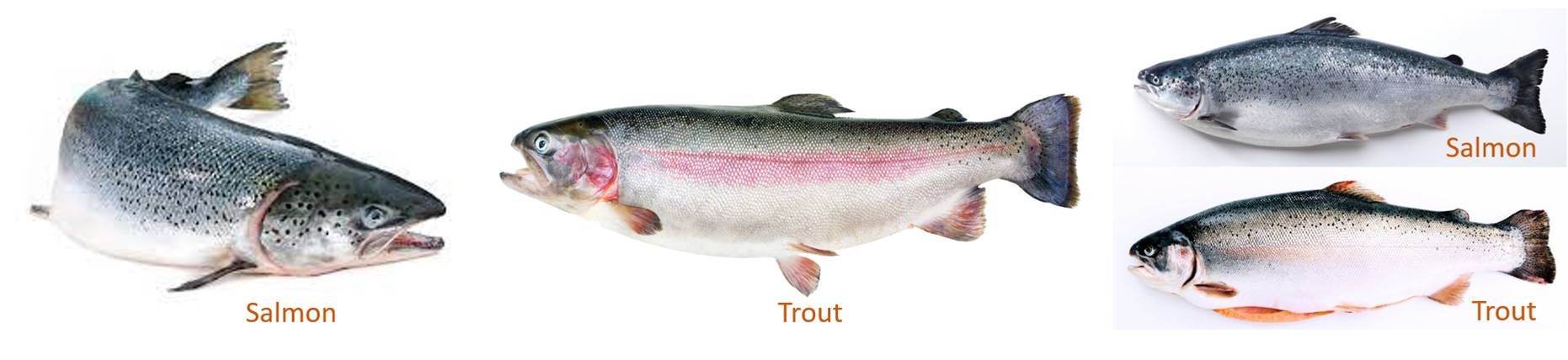
There is a misconception that a trout turns into a salmon after entering the sea.
In the modern market, we often find fish sold as salmon, when in fact, it is trout!
Although trout and salmon belong to the same family, they are still different species of fish that live in different environments and have different origins, behavior, appearance, texture, and taste.
The main difference between the two is that trout is a freshwater fish while salmon is a saltwater fish. The texture of trout meat is soft and tender, and the taste is mild. Salmon, in general, has a lower fat content, and the taste is very strong and luxurious.
There are cases when trout is raised in sea water, which significantly changes its taste. This is the reason why trout is mistakenly called salmon.
Both types contain high amounts of protein, vitamins, minerals, and omega-3 fatty acids. Taking its fat significantly improves human health. Fish, along with being useful, is a delicious product and a popular ingredient of many countries’ traditional dishes.


The correct labeling
Correct fish labeling helps the consumer to make the right choice, whether to buy trout or salmon.


